Back to the Future // Lilac Madar
In the decade since she published the final issue of Forno Magazine, which featured "a rain of organs, in all colors and all kinds," Lilac Madar has come to understand that art is also a therapeutic tool. "Being part of an artwork, giving, receiving, changing, experiencing, there's no substitute for that."
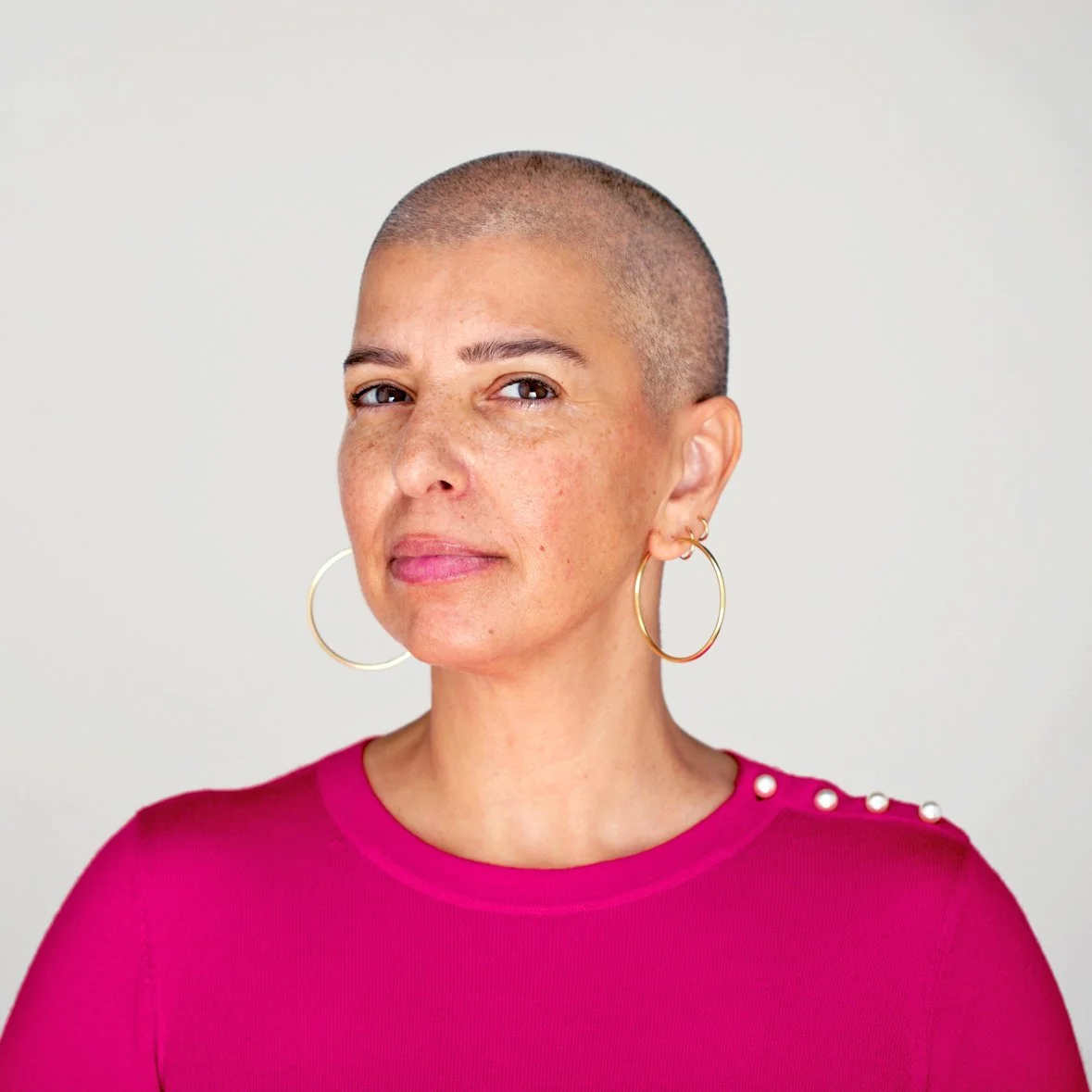
Lilac Madar. Photo: Malkiella Ben Shabbat
10 Years Ago
In 2003, Lilac Madar published the first issue of Forno Magazine, aiming to confront explicit sexual imagery in positive, playful, colorful, and thought-provoking ways, and to "challenge the convention that sex images = abomination."
"Each issue brought surprising insights: ‘cunnilingus’ (#1) sparked a burst of creativity and joy, the ‘Fellatio’ issue (#2) sold out the fastest to date," Madar told me 10 years ago before launching issue #11, which featured "a rain of buttocks, in all colors and all kinds. I discovered that for many artists, the word 'virginity' brings up trauma, and 'anal' is still taboo."
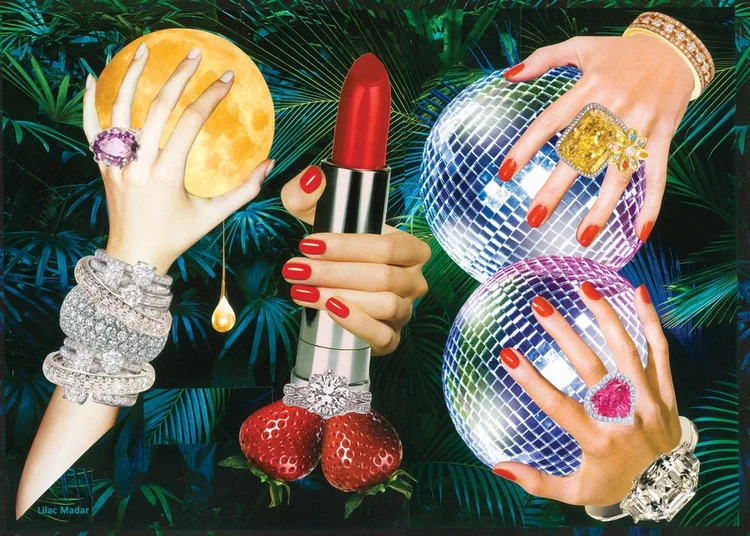
Lilac Madar, 2014, Forno Magazine #9.10 – Teats and Testicles
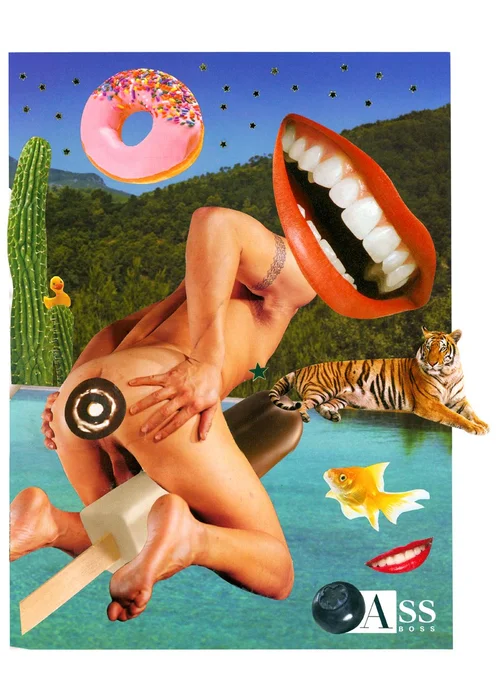
Lilac Madar, 2016, Forno Magazine #11 – Buttocks
"Tel Aviv is a bubble just like Tokyo, Berlin, Paris, and Barcelona are bubbles. But the Israeli audience, even if traditional or conservative, has a spark of curiosity and openness."
"We conducted this interview just before one of Forno's crazy launch parties, and I didn't know then that it would be the last issue and the last launch," she says now, a decade later. "Looking back, it was exactly the seam between the end of the Forno era and the beginning of my breakthrough as an individual, exhibiting and active artist.
Looking back, it was exactly the seam between the end of the Forno era and the beginning of my breakthrough as an individual, exhibiting and active artist
"The first issue of Forno was printed in summer 2003, and for 13 years it was the center of wild, colorful, and super-invested creation, bringing together all the young (then) and rising talents in art/design/comics. The magazine came out during a very fertile period in Tel Aviv and Israel in general, and a whole scene of events, comic and subversive zine fairs, merchandise, and a great burst of creation and activity by many talented people, parties, and performances formed around it.
"There were many articles about us in the press then (most of these publications no longer exist in print), and I even participated in several TV shows (I remember most the experience on the famous ’ London and Kirshenbaum ’ program. The latter, may he rest in peace, came to greet me in the makeup room. I told him how excited I was, and he said: 'Don't worry, we won't let you get a word out')."
And also abroad.
"Yes, beyond that, I also traveled with the magazine to comic fairs around the world, at Comic-Con in San Diego, at the Angoulême Festival in France, at the Tokyo Book Fair, and I met and worked with international artists. I managed the entire operation myself and learned a lot about the printing world, working with artists, distributors, and the audience. I myself developed as an artist from issue to issue; this was my main platform for showcasing my art.
"Although during this period only 11 editions were published, and I did a million other things, everything revolved around the magazine; Forno was the center of my world, the challenge and happiness of my life."
Fast Forward
After more than a decade, two parallel things happened. One, Madar says, she found it increasingly difficult to find content for the magazine. "All the artists and designers who grew up with me from Bezalel and other institutions became functioning adults, established their professional careers, started families, were less motivated to deal with these topics, had less free time, and it also suited them less to work for free. I felt I had no dialogue with the younger generation, who seemed a bit uptight and boring to me (sorry guys)."
The second thing was the Master's degree she completed in Art History, which gave her new insights about her practice and the field she was interested in working in. In 2015, her first solo exhibition, "An Eye for an Eye," took place at The Artist House (Elharizi), where she presented a full series of Stamp-Loupes that garnered enthusiasm and sales. In 2018, she exhibited at the Fresh Paint Art Fair a giant wall of Stamp-Loupes ("I made a little history when they were all sold out on opening night").
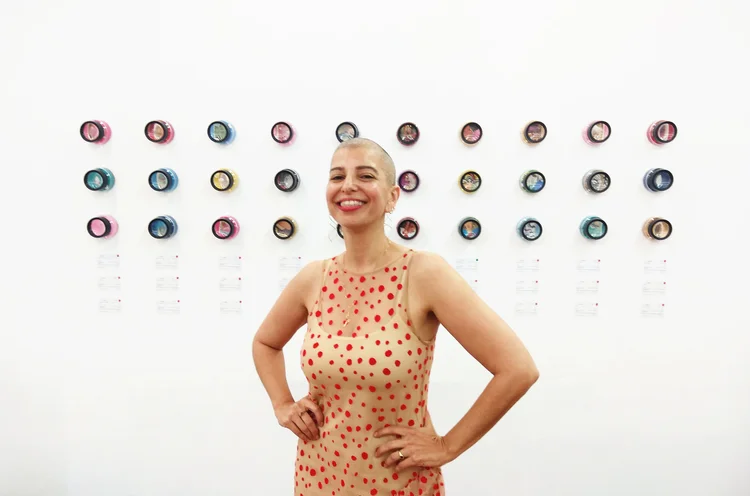
Fresh Paint, 2018. Photo: ML
"The Stamp-Loupes are a central part of my work in the last decade and beyond, a bit like Forno, I present them around the world, and grow with them. At that same Fresh Paint Art Fair, I also presented three assemblages that together with the Stamp-Loupes marked the beginning of a transition to three-dimensional works, continuing the collage line of found materials, but on a larger scale, and more dynamic."
October 7 found Madar in New York, a day before an installation in a group exhibition. “Hanging the wall of Stamp-Loupes was exhausting and took me long hours. I was in a borderline mental state, like all of us. I looked at the colorful, playful installation and felt on the edge of an abyss; the art seemed meaningless and unnecessary to me. I just wanted to go home."
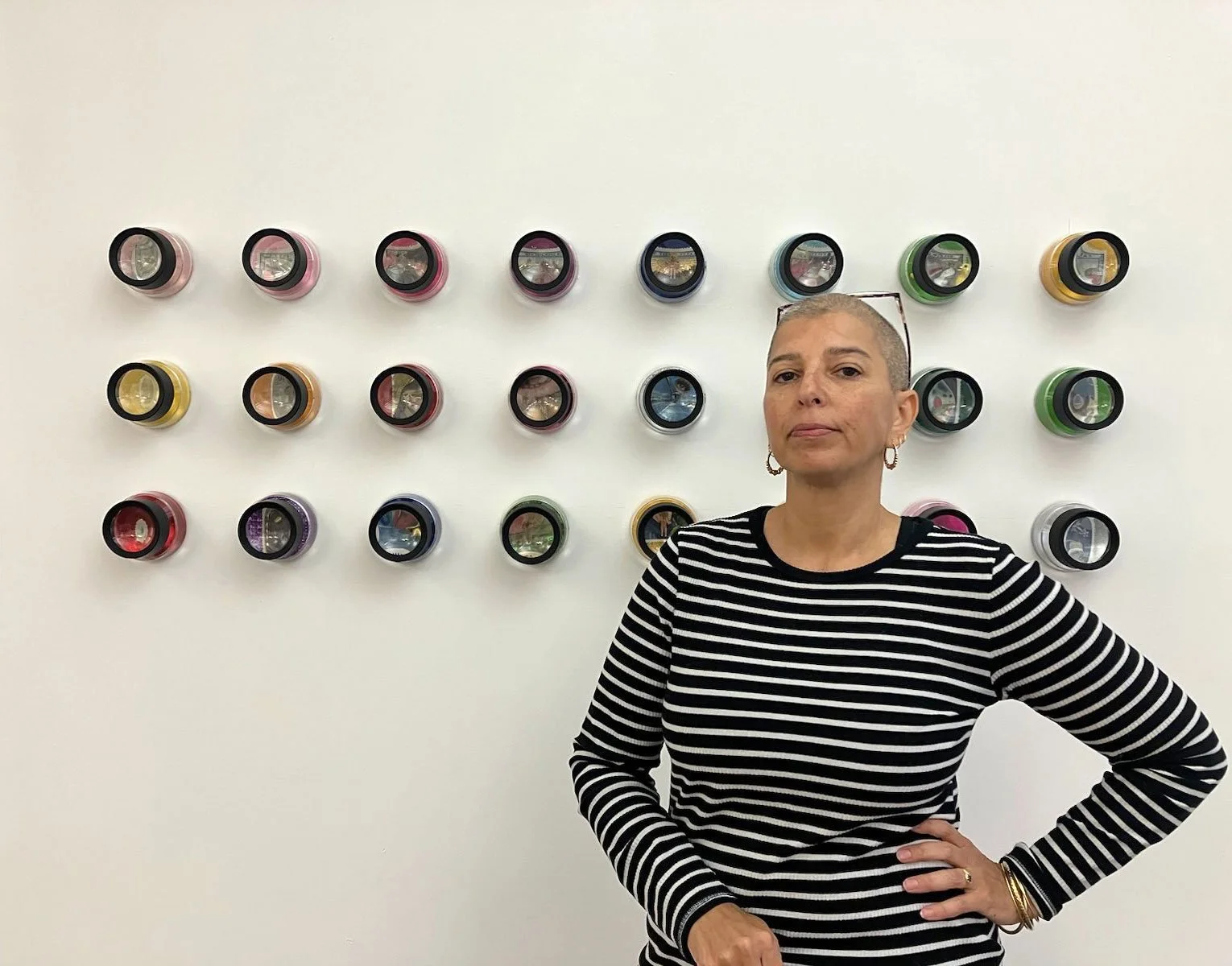
Lilac Madar, New York, 2023
What did you do?
"A little before that trip, I moved to live in Jaffa after more than 20 years living in Florentin, and I was looking for solace for my artistic helplessness. It occurred to me to start a support group. I managed to get funding from the Jaffa-Tel Aviv Municipality, and we met once a week at 'Kagdilart' in Tachiyah 14.
The hanging was exhausting and took me long hours; I was in a borderline mental state, like all of us. I looked at the colorful, playful installation and felt on the edge of an abyss; the art seemed meaningless and unnecessary to me. I just wanted to go home
"It turned out that most of the group participants came from the field of performance. There, the idea for the PoppyPink project was born, dealing with the tragedy of the female hostages. I had already accumulated some experience in the field, intimate installations I conducted with the study group at Etti Abergel's at Kerem Institute (I studied there for two years for a teaching certificate in art), the participatory shrines in my 'Spell' exhibition at the Gordon-London Gallery in Rishon Lezion (curated by Efi Gen in 2020), and the Old Glory installation born in my residency at SVA in New York in 2022."
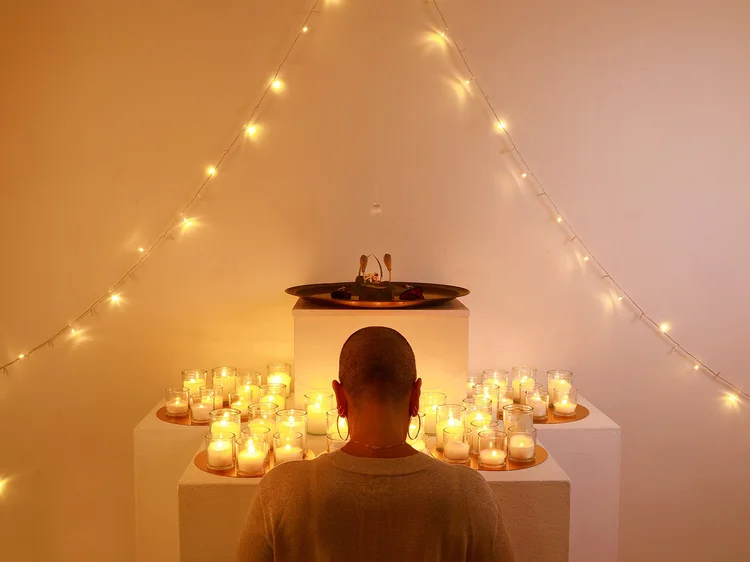
The Longing Shrine, 2020, London-Gordon Gallery Rishon Lezion. Photo: Malkiella Ben Shabbat
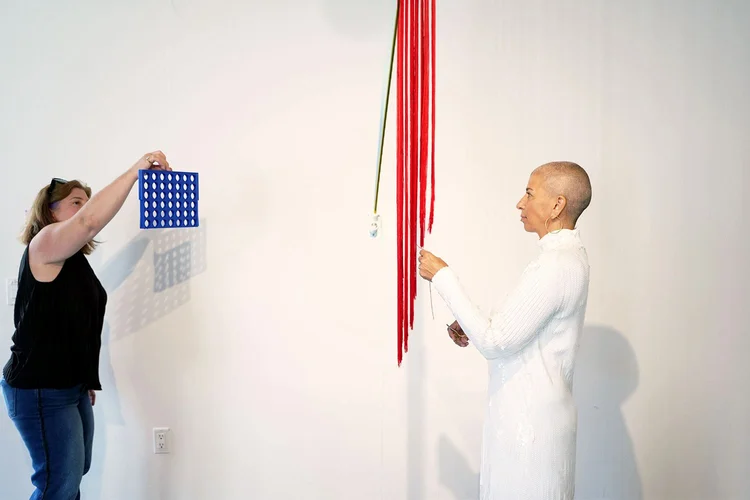
Old Glory, New York, 2022. Photo: Yonatan H. Mishal
What can you tell us about PoppyPink?
"PoppyPink was an ambitious project. The timeline was very tight because it was important to me to present it on the first anniversary of October 7. The production was complex, and I needed to raise a significant budget to realize it. The idea was to wear a knitted pink dress that unravels during my walk in Central Park in New York, and the audience would follow me, leaving the thread on the path. I felt it burning inside me, and that I had to make art with and about my physical body.
"Haya Nir, the legendary designer of 'Katomenta' and knitting mentor, knitted me a prototype of the dress. I was driven by purpose, James Snyder and the Jewish Museum rallied to the project, and helped with funding that came from private individuals, companies, and philanthropists."
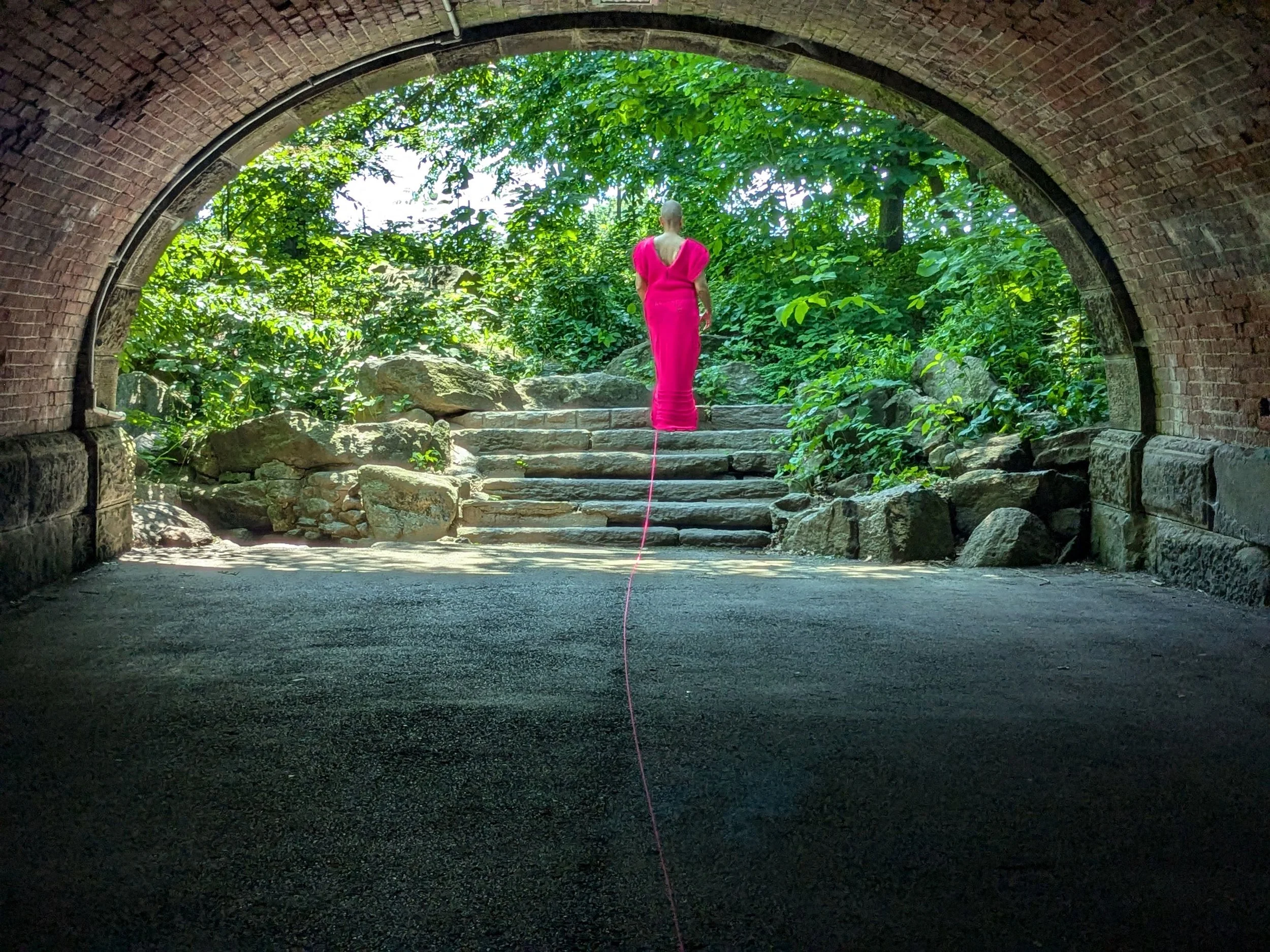
PoppyPink, New York, 2024. Photo: Yonatan H. Mishal
"The dress (the second one) that Haya Nir knitted was exhibited at the Jewish Museum before the installation, and on the anniversary (on the Hebrew date), alongside participants of Jews, Israelis, and passersby audience who came to share the pain and mourning. I found myself breaking down in tears during the event when I entered the tunnel on the walking path.
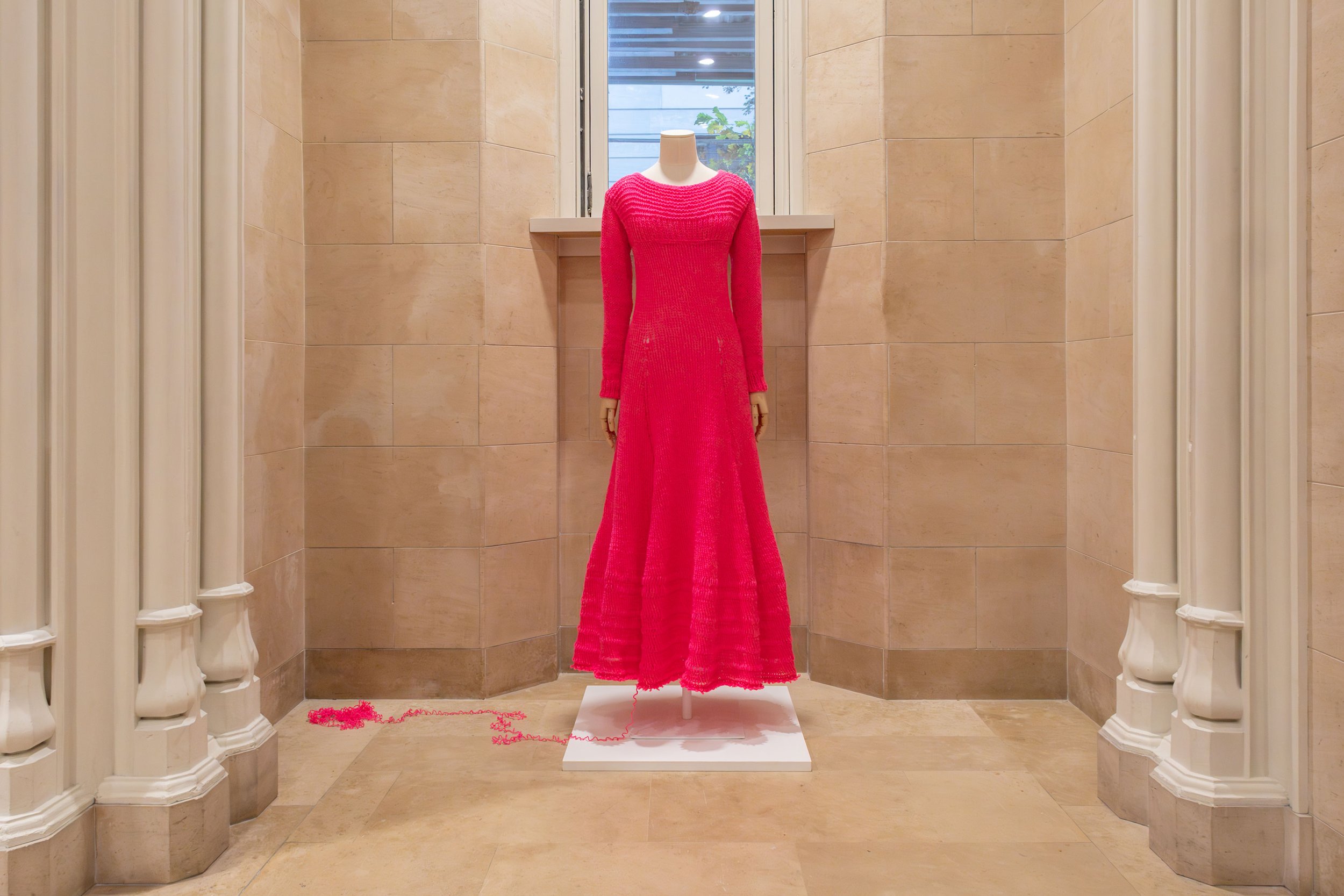
PoppyPink, The Jewish Museum New York, 2024. Photo: Shani Barel
"This was the first time I allowed myself to cry since the October 7 massacre. I felt the power of the audience within my art, and its strength as a tool of healing and solidarity. And yes, art is also a therapeutic tool, don't listen to what they teach you at Bezalel."
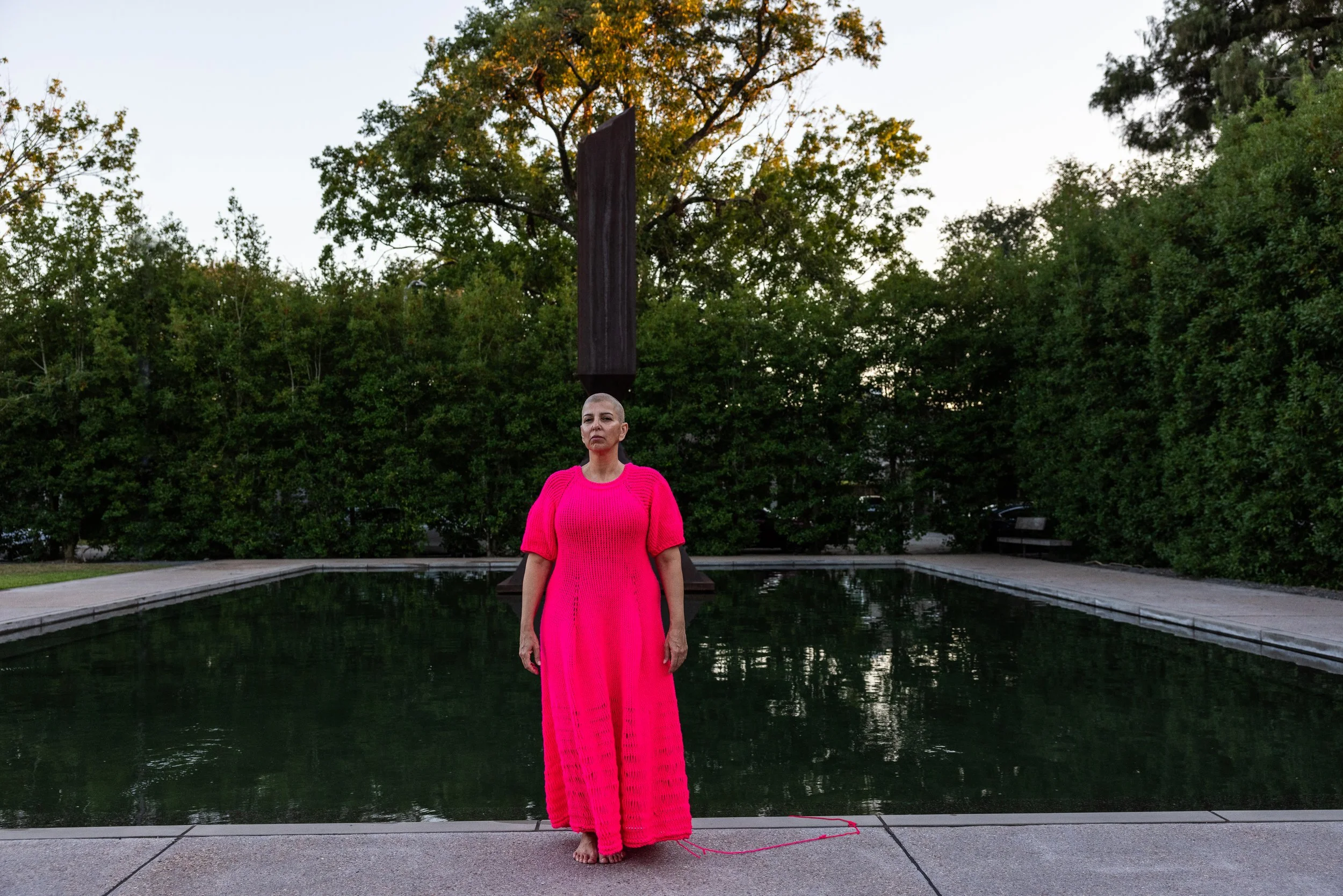
PoppyPink, Houston, Texas, 2025. Photo: Shani Barel
10 Years Later
"We are in an era of digital and social networks and AI, and alongside this, the need for physical encounters and a return to crafts is strengthening. The entire fiber art scene is very big in the art world, and performance receives significant attention as well. Exhibiting in a white cube- in a gallery or museum space- is solid and important, and I'm not abandoning it. Still, it doesn't compare to interaction with an audience, and I say this both as an artist and as an audience member."
Exhibiting in a white cube- in a gallery or museum space- is solid and important, and I'm not abandoning it. Still, it doesn't compare to interaction with an audience, and I say this both as an artist and as an audience member
Can you elaborate?
"Being part of an artwork, giving, receiving, changing, experiencing, there's no substitute for it, and that's where I'm headed these days. The thing about participatory performance is that, to create it, you need to enter a process involving a working group. This was true in 'Kerem,' in the residency at SVA, and in the 'Artist-Support' group in Jaffa.
You need to test the materials in a structured way and get feedback, and that's something special that doesn't happen every day. It's not like daily work in the studio, cutting collages or assembling assemblages. It's a process that requires shared space and commits to a certain way of working."
"Just before the current war, I finished a course at Da Vinci Culture Center, 'Particle Accelerator' led by Alit Kreiz. Alit, by the way, helped me when I was working on PoppyPink, and I owe her the powerful closure of the event.
"In any case, in the process with the group, I created the work 99:1, which talks about bureaucracy in the art world, and about rejection and failure that touch everyone actually. It's work that expresses pain, but it's humorous and surprising. It warms the heart to make people smile and even laugh."
In 10 More Years
"Our lives as artists are closely affected by the political situation. It's very challenging to continue creating in such an atmosphere of endless war and uncertainty. After October 7, I felt I couldn't exhibit in Israel, not from ideology, and not because I thought it wasn't appropriate or okay. It was completely personal; I felt I needed to wait until all the hostages returned and to act for the cause.
"And then we had a few moments of grace, and returned to the loop. For me, as someone who lives between Israel and the US and works very hard to advance my international career, it puts a spoke in the wheel each time and forces me to reinvent myself (visit @tuesdaytov on Instagram). Maintaining an artist's life is challenging anyway, so our situation here is very exhausting, for the entire artist community, and certainly for those who have international aspirations."
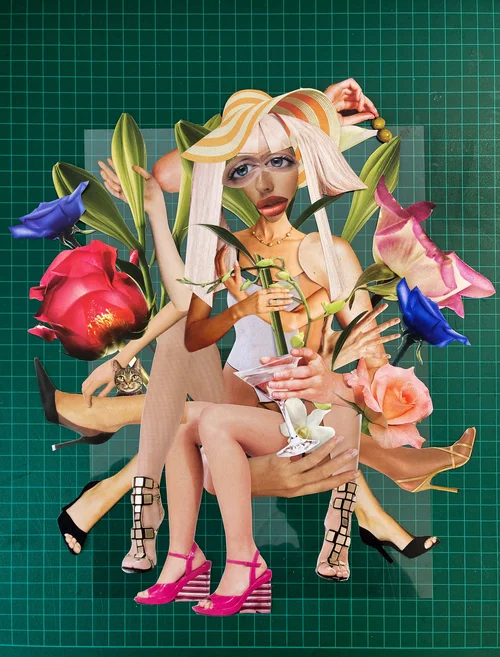
Collage in progress on the work table during wartime, 2026. Photo: ML
"So, to your question, first of all, I want quiet. I want peace, to live normal lives, with a government that works for the citizens, with functioning authorities, with respect between people, without violence, without destruction. I want to live in a liberal and prosperous Middle East, continue making art that speaks to people, and be part of a global community.
I want us to return to talking about climate, about nature, and about growth. That culture, art, and education will be at the center of our lives. I want to be there."
Further Reading
"Since at the time of writing these lines, there's not really an option to travel the world, and everything here is also pretty closed, I want to recommend the podcast named ‘A Brush With.’ In each episode, there's an in-depth interview with an artist; the interviewer, Ben Luke, is an art journalist, and he manages to conduct fascinating and super-concrete conversations with artists, not just philosophical talk. From my favorite episodes (to which I listened more than once): Linder Sterling, Tino Sehgal, and Ellen Gallagher."